
If you’re setting up or upgrading to commercial air conditioning for small offices, you’ve likely already narrowed it down to two contenders: a split system or a ducted reverse-cycle system. Both are popular, both are effective, and both have a strong case depending on your specific situation.
The problem is that most of the advice floating around online is written with residential properties in mind. A small office has different demands. You’re managing staff comfort, professional presentation, and energy bills that sit in the business accounts. In many cases, a leased space where what you can and can’t do is shaped by what your landlord permits.
This guide is written specifically for small commercial offices. We’ll break down how each system works, what each costs, what the real-world trade-offs are, and how to work out which one is the right fit for your space.
Understanding Your Options for Commercial Air Conditioning for Small Offices
Before comparing the available commercial air conditioning for small offices head-to-head, it’s worth being precise about what each one actually is in a commercial context.
Split Systems (Including Multi-Head Splits)
A split system consists of an indoor wall-mounted unit and an outdoor compressor unit connected by refrigerant piping. In a small office with multiple rooms or zones, this typically means installing individual single split systems in each space. Alternatively, you can opt for a multi-head split system. This is where a single outdoor unit connects to multiple indoor units across different rooms.
All modern split systems for commercial use are reverse-cycle. This means they provide both heating and cooling from the same unit. For a small office context, multi-head splits are worth understanding on their own terms. They deliver the room-by-room independence of individual units while reducing the number of outdoor compressors. This is when outdoor space or body corporate restrictions are a factor.
Installed costs for a single commercial-grade reverse cycle split system varies. It typically ranges from around $3,000 to $10,000 per unit, depending on capacity and brand. A multi-head system connecting several indoor units to one outdoor unit sits in the range of $4,200 to $8,000 for the full setup. However, this varies significantly with the number of indoor heads and system capacity.
Ducted Reverse Cycle Systems
A ducted reverse cycle system has a single indoor unit, typically housed in the ceiling cavity or roof space. It’s connected to a network of ducts that deliver conditioned air through ceiling vents throughout the entire office. A central thermostat or zoning panel controls the system. Its modern systems offers zone-by-zone control that lets you direct airflow only to occupied areas.
For a small office, a fully installed ducted reverse cycle system generally costs between $9,000 and $17,000. The cost depends on the size of the space and the complexity of the ductwork. On top of those, the brand and capacity of the system chosen are factors as well. For larger or more complex jobs, that figure can climb beyond $20,000.
The Key Differences That Matter in Commercial Air Conditioning for Small Offices
1. Upfront Cost
Split systems win clearly on upfront investment. A single high-quality commercial split system for a primary workspace costs a fraction of a fully ducted installation. If budget is tight, or if you’re in a leased space and reluctant to make a major capital commitment, split systems are the more accessible entry point.
A ducted system asks for a larger upfront spend but delivers a complete, integrated solution across the entire space. It’s an investment that makes strong financial sense over a 5 to 10-year horizon. This is suitable for a business owner who owns the premises. Additionally, a long lease and a strong interest in the quality of the workplace environment are sound factors.
2. Installation Disruption and Complexity
Split systems are simpler and faster to install. A single unit can typically be operational within a few hours. On the other hand, a multi-head system covering several rooms can usually be completed within 1-2 days. Significant ceiling works, running ductworks, and contained installation footprints aren’t needed.
Ducted installation is more involved. It requires access to the ceiling cavity for the indoor unit and ductwork, and ceiling vents need to be cut in each zone. In a leased office, this level of work almost always requires landlord approval, and some leases restrict or prohibit it entirely. In a building where other tenants share the structure, there may be further approvals required. The installation timeline is longer, typically two to five days depending on the complexity.
If you’re in a tenancy with limited ceiling space, no roof cavity, or a landlord who won’t approve structural modifications, ducted air conditioning may simply not be an option, regardless of how well it might suit the space.
3. Aesthetics and Presentation
For client-facing offices, how the system looks matters. This is one area where the two systems diverge noticeably.
Ducted systems are largely invisible. Conditioned air comes through discreet ceiling vents, and the system itself is hidden in the ceiling cavity. There’s no wall-mounted unit to accommodate in a fitout, no bracket on an exterior wall, and the overall aesthetic of the office is clean and uninterrupted. For professional environments where first impressions count, including legal, financial, medical, and design practices, this is a genuine advantage.
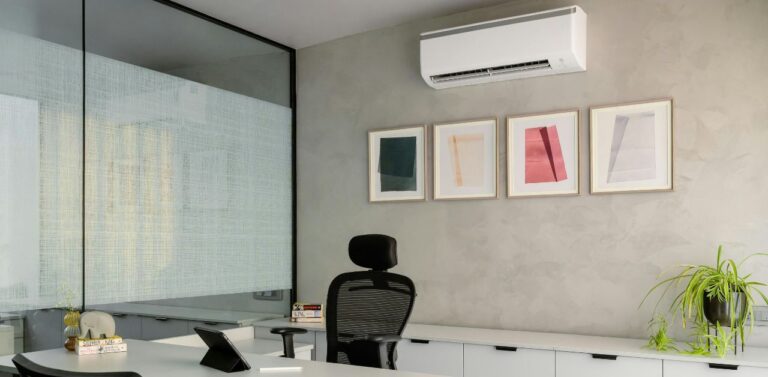
Split systems are visible by design. The indoor unit sits on an interior wall, typically at high level, and requires wall penetrations and external piping that runs to the outdoor unit. Modern units are sleeker than they used to be, and some offices integrate them well into fitouts. But if you’re working with a carefully considered interior design or client-facing reception area, wall-mounted units can be a compromise.
One middle-ground option worth considering in commercial contexts is a ceiling cassette unit, which sits flush within a suspended ceiling and delivers air in four directions from a central point. It offers much of the visual discretion of a ducted system at a lower installation cost, and is well suited to open-plan small offices with suspended ceilings.
4. Zone Control and Flexibility
In a small office, different areas often have different needs throughout the day. A meeting room that’s empty most of the time shouldn’t be conditioned the same way as a busy open-plan workspace. The reception area where clients enter may need to be kept at a consistent temperature regardless of what’s happening in the back offices.
Both systems can accommodate this, but they do so differently.
With split systems, zone control is built in by default. Each unit operates independently, so staff can adjust the temperature in their own workspace without affecting the rest of the office. This simplicity is genuinely useful in a small team where individual comfort preferences vary. The trade-off is that running multiple split units simultaneously in all areas at all times can be less efficient than a properly zoned ducted system.
With ducted reverse cycle, zoning is achieved through motorised dampers in the ductwork, controlled by a central panel or, in modern systems, a smart controller or app. Well-designed zoning lets you direct conditioned air only to occupied areas, switching off or reducing flow to empty rooms. This is efficient and elegant, but adds to the installation cost and requires thoughtful initial design to work well.
For a very small office of one or two rooms, the zoning advantage of a ducted system is largely irrelevant. For an office with four or more distinct spaces that are used independently, ducted zoning starts to offer meaningful efficiency benefits.
5. Running Costs and Energy Efficiency
Both systems use reverse cycle technology, which means both are dramatically more energy-efficient than older heating and cooling alternatives. The efficiency gap between the two systems is less about the technology itself and more about how each is used.
Split systems are most efficient when you’re only conditioning the specific rooms you need at any given time. If half your office is empty each afternoon, running only the units in the occupied areas is simple and cost-effective. Modern inverter-driven split systems are highly efficient and quiet, with top brands including Daikin, Fujitsu, Mitsubishi Electric, and Panasonic all offering commercial-grade units with strong energy ratings.
Ducted systems with good zoning can match or exceed split system efficiency across a whole-office view, but only if the zoning is set up correctly and used consistently. A ducted system running without zoning, conditioning the entire office evenly regardless of occupancy, will use more energy than a set of split units running only where needed.
For budgeting purposes, productivity drops significantly above 24°C, which means the cost of an inadequate or poorly performing system isn’t just measured in electricity bills. It shows up in output and staff wellbeing too.
6. Noise Levels
Noise is a factor that often gets overlooked until after installation, and it matters considerably in a professional environment.
Modern split systems have become much quieter than older models, and premium inverter units from leading brands operate at indoor noise levels that are genuinely unobtrusive. That said, some units are noisier than others, and in a quiet open-plan office or meeting room, even moderate fan noise can be a distraction.
Ducted systems are widely regarded as the quieter option in use. The indoor unit sits out of sight in the ceiling cavity, and the only in-room components are the ceiling vents, which produce minimal noise. For boardrooms, consulting rooms, and spaces where concentration or confidentiality matters, this is a meaningful difference.
7. Maintenance and Servicing
Both systems require regular professional servicing to maintain performance and meet the requirements of most commercial warranties.
Split systems are generally simpler and cheaper to service. A standard service call for a split system costs around $200 per unit, and each unit can be serviced independently. If one unit needs repair, the rest of the office remains operational.
Ducted systems are more complex and typically cost more to service, with professional servicing running around $400 or more depending on the extent of the work and whether ductwork cleaning is required. The entire system is interconnected, which means a fault in the main indoor unit or outdoor compressor affects the whole office rather than a single zone.
For multi-head split systems, it’s worth noting that the outdoor unit is shared. If it develops a fault, all the connected indoor units go down simultaneously, which removes one of the usual resilience advantages of individual split systems.
Which Commercial Air Conditioning for Small Offices System Suits Which Type?
Rather than declaring a definitive winner, the more useful approach is matching each system to the situations where it genuinely performs best.
A split system (or multi-head split) is likely the better fit if:
- You’re in a leased space and have limited ability to make structural modifications
- Your office has limited ceiling space or no accessible roof cavity
- Budget is a primary constraint and you need a quality solution at lower upfront cost
- You have a small number of rooms (one to three) with straightforward conditioning needs
- You want the flexibility to expand or reconfigure cooling as your team grows
- Installation speed matters and you can’t afford extended disruption to operations
A ducted reverse cycle system is likely the better fit if:
- You own the premises or have a long-term lease with landlord approval secured
- Professional presentation and a clean aesthetic are important to your brand
- Your office has four or more rooms or zones that all need conditioning
- You want consistent, whole-office comfort managed from a single control point
- Noise levels are a priority concern, particularly in client-facing or concentration-heavy spaces
- You’re fitting out a new or refurbished space where installation can happen before the team moves in
A ceiling cassette unit is worth considering if:
- You have a suspended ceiling in an open-plan space
- You want better visual integration than a wall-mounted split system allows
- The space doesn’t have the roof cavity depth needed for full ducted ductwork
- You’re conditioning a single open area rather than multiple separate rooms
Getting the Commercial Air Conditioning for Small Offices’ Sizing Right
Regardless of which system you choose, sizing it correctly for your specific space is the most important technical decision in the process. An undersized system will struggle on hot days and run constantly, burning electricity and wearing out components faster than it should. An oversized system will short-cycle, switching on and off repeatedly, which reduces efficiency and fails to adequately control humidity.
Commercial spaces have additional sizing considerations that don’t apply to residential settings, including the number of people regularly occupying the space, the heat generated by computers and other equipment, the orientation and glazing of the office, and whether the space is in a multi-storey building where heat loads differ from ground-floor to upper-level tenancies.
A qualified commercial air conditioning technician will assess these factors and recommend the correct capacity before any equipment is specified or purchased. This assessment step is not optional if you want the system to perform the way it should.
A Note on Compliance and Licencing
Any commercial air conditioning installation in Australia must be carried out by a licensed technician holding an ARCtick licence, which is the national licence for handling refrigerants. This requirement applies to both split systems and ducted systems. In a commercial tenancy, your installer should also be familiar with the relevant building code requirements and any body corporate or landlord-specific rules that govern the work.
Choosing an experienced commercial installer, rather than a residential-focused operator who occasionally takes on office jobs, will ensure the work is done correctly, the system is commissioned properly, and the warranty is protected from the outset.
Ready to Cool Your Office the Right Way?
At Tailored Heating and Cooling, we work with small businesses and commercial tenants across Australia to design and install air conditioning systems that are properly sized, professionally installed, and suited to the way the space is actually used.
Whether you need a straightforward split system for a two-room office or a fully zoned ducted solution for a growing team, we’ll give you honest advice on the right commercial air conditioning for your office and a quality installation you can rely on, day in and day out.
Book a consultation with Heating and Cooling today and let’s find the right commercial cooling solution for your office.